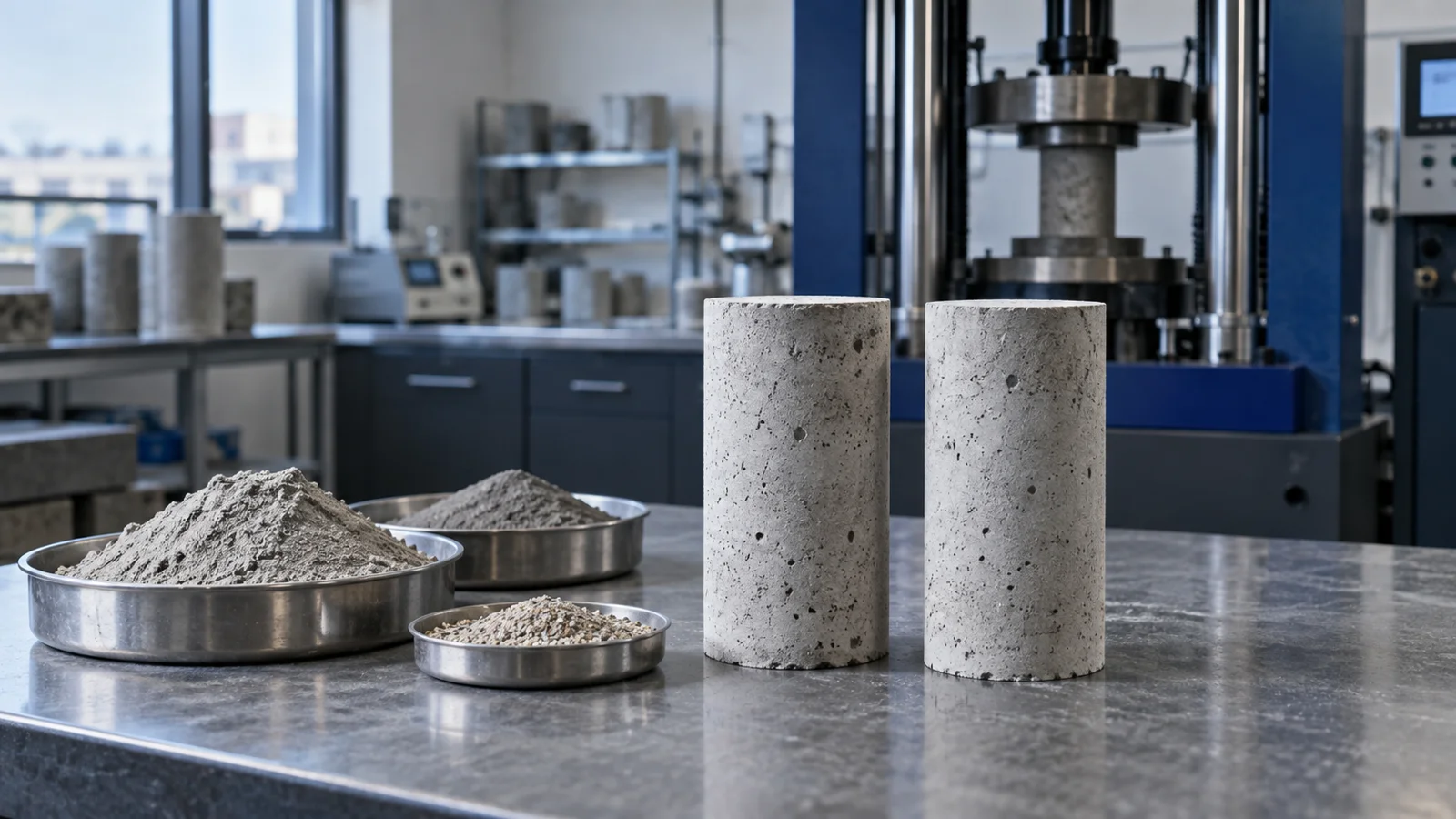
A concrete submittal arrives with a promising headline: 30% cement replacement. The proposed mixture meets the specified strength, and its reported carbon footprint is below the project baseline. For an engineer reviewing the submission, this is encouraging. The next question is whether that advantage survives the conditions under which the concrete will actually be produced, placed, cured, and used.
That is where a credible carbon reduction strategy becomes an engineering decision. Replacement percentage belongs in the discussion, but it cannot carry the decision alone.
Look beyond the replacement percentage
Start with the constituent quantities per cubic metre. At 30% replacement by mass, a mixture containing 360 kg/m³ of binder uses 252 kg/m³ of cement; one containing 420 kg/m³ uses 294 kg/m³. The replacement percentage is identical, but the cement demand is not.
Using the same hypothetical emission factors for both mixtures, the second would also have higher binder emissions. This arithmetic does not establish equivalent performance; it shows why total binder content belongs beside replacement percentage in every comparison.
Material identity matters just as much. Fly ash, slag cement, and other supplementary cementitious materials differ in reactivity, composition, and interaction with the cement and admixtures. Their effects on setting, strength development, and durability depend on the actual combination. FHWA specifically recommends verification in concrete when a fly ash source changes. [1]
Same replacement. Different binder emissions.
Establish a defensible carbon comparison
An environmental product declaration, or EPD, reports environmental impacts within a defined scope. It does not certify that a mixture is suitable for a particular structure. NRMCA distinguishes declarations for specific products from broader industry averages; these serve different purposes when assessing a supplier’s proposed concrete. [2]
For a practical submittal review, check that the comparison uses consistent units, compatible product category rules, and the same life cycle boundary. A1–A3 covers raw material supply, transport to the concrete plant, and manufacturing. It excludes delivery of the finished concrete to site and subsequent construction, use, and end of life. [3]
Record the required strength and test age, exposure requirements, and construction constraints alongside the carbon result. A comparison per cubic metre is useful for screening, but equal volume alone does not demonstrate equal function or service life. If the alternatives require different structural quantities or maintenance, the assessment must address those differences.
Qualify the mixture for the work
Develop the trial program around the decisions that matter on site. Verify workability retention and setting against delivery and placement windows. Assess strength at the ages needed for stripping, loading, or opening to traffic. Select durability tests for the anticipated exposure rather than relying on compressive strength alone.
SCMs can improve concrete performance, but their benefits are conditional. Some combinations develop strength more slowly at early ages; fly ash characteristics can also affect air entrainment. Qualification should therefore use the proposed material sources and admixtures, with curing and temperature conditions relevant to the work. [1]
Where later strength acceptance is proposed, agree it with the designer and construction team. A later test age does not remove an earlier loading requirement.
Make the decision traceable
I recommend a short comparison sheet containing the mixture quantities, EPD reference and boundary, trial results, curing requirements, and outstanding qualifications. Define which changes in material source or proportions require renewed review.
The preferred mixture should have a substantiated carbon advantage and evidence that it can meet the project’s construction and durability requirements. That is a stronger basis for specification than a replacement percentage or an isolated carbon number.